

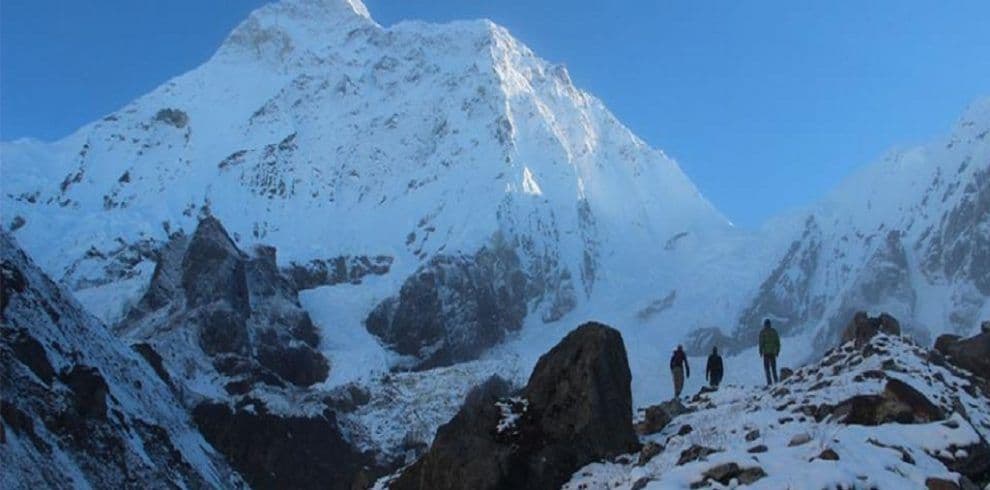
Makalu Base Camp Trek
Overview
Nepal, as a tourist destination is good for all seasons, however, the best seasons for trekking to Khumbu region are Spring (March – May) and Autumn (mid Sept. – mid Dec. ). Trekking in autumn season is noted for clear weather and excellent views of silvery mountains against blue sky. It gets colder towards the end of December. This trek can be done in any month except January and February.
The Highlight of the Makalu Base Camp Trek
Close view of the 5th highest mountain in the world explores the wonderful landscape.
Spectacular view of Mt. Makalu, Mt. Everest, Mt. Baruntse, Mt. Lhotse.
Great view of Makalu Barun National Park and Arun Valley.
View of Rhododendron forest, beautiful glaciers, and majestic Himalayas.
Trip Summary
Makalu Base Camp (5250m/17224ft) situated in the eastern part of Nepal provides you with unexpected moments of your life. Makalu Base Camp Trek provides you with a great chance to explore the unique Tibetan culture of people with their own different languages, traditions, customs, rituals, norms, and their daily living style. Along with this, the region offers you amazing wildlife in beautiful pine and bamboo forests. Here you can closely explore the many endangered species like wild dogs, musk deer, and blue sheep. Makalu Barun National Park (containing more than 3000 flowering plants, 67 species of medicinal plants, home of more than 50 species of animals, and 400 species of birds). Dense forest, valleys of the Barun River, great waterfalls, and deep gorges are the main attractions of this trek.
The 5th highest peak, covering 2330 sq.km at 8485m (27838 ft.), close to Mt. Everest, Makalu Barun lies in the northeast region of Nepal. The stunning shape of Makalu and the region is blessed with an incredible diversity of natural beauty. The ethical Tibetan group of people (Sherpas) live at higher elevations. Though the region is economically poor & isolated, they retain a rich cultural heritage. Makalu and Barun play an important role in trekking and mountaineering itself.
Talking about Makalu Barun National Park, it was established in 1992. The northern part of the park is covered with dense forest, valleys of the Barun River, great waterfalls, and deep gorges. The park contains more than 3000 flowering plants, 67 species of medicinal plants, home of more than 50 species of animals, and 400 species of birds. We can experience the varieties of cultures and landscapes with their spectacular views here. Makalu Base Camp Trek is one of the famous treks in Nepal offering you splendid views of high-altitude terrains, snow-clad landscapes, and ethnic Himalayan lifestyle. Makalu lies in the Eastern region of Nepal. In fact, it is located in the Mahalangur Himalayas 19 km (12 mi) southeast of Mount Everest, on the border between Nepal and China. Makalu (8,463 meters (27,766 ft)) is the fifth highest mountain in the world. Makalu is an isolated peak whose shape is a four-sided pyramid. Though this beautifully shaped mountain climb attempt was made by an American team led by William Siri in the spring of 1954 for the first time, it was first climbed on May 15, 1955, by Lionel Terray and Jean Couzy of a French expedition.
Likewise, the Makalu Trek is a chance to mesmerize through an unspoiled Himalayan landscape far from the trapping of the modern age. This trek starts with the sightseeing tour of world heritage sites in Kathmandu. From Kathmandu, you take a flight to Tumlingtar. Then the jeep drives to Num where we commence our trek to Makalu Base Camp. Your trail further passes to high-altitude regions following and accommodating at local teahouses/tented camps. The trek passes through villages such as Seduwa, Tashigaou, Khongma, Dobato, Yangle, Langmale and finally destined to Makalu Base Camp. People living in this part of the country belong to four main communities: the Sherpas, Rai, Newars, and Limbus. These ethnic groups, although practicing different rituals, believe in the same philosophy of simple living.
What‘s Included
What‘s Excluded
Availability
Select your preferred departure date. Trip duration: 22 days
| Su | Mo | Tu | We | Th | Fr | Sa |
|---|---|---|---|---|---|---|
| Su | Mo | Tu | We | Th | Fr | Sa |
|---|---|---|---|---|---|---|
Number of Travellers
Select a date to book
Dates are subject to availability. Please contact us to confirm your preferred dates.
Itinerary
You are welcomed by hospitable meeting and then you will be transferred to your hotel. Our airport representative will explain briefly the program upon arrival. Overnight at hotel
Sightseeing of world heritage sites in Kathmandu valley including, Kathmandu Darbar square, Swayambhunath Temple, Boudhanath Stupa & Pasupatinath Temple. You can get a chance to observe the ancient structures reflecting the legendary histories of ancient Kings. All of them offer you the ancient artistic style of Nepalese people. Along with this visiting near the Kathmandu valley provides a chance to observe the locals lifestyle and religious values. Overnight at hotel, breakfast included.
After breakfast we take a flight from Kathmandu to Tumlingtar. During the flight we get to see the beautiful views of snowy peaks. We then take a jeep to Chichira, Chichira is a small settlements of Gurung people. So, we can closely observe the daily practicing cultures and traditions of Gurung people. Here we take rest and be prepared for our next trek. Overnight at tented camp, meals included: breakfast, lunch and dinner included.
Early in the morning we start our trek to Num from Chichira. This trek leads us through the amazing lush green forests trail. Passing the forests we get to observe the amazing settlements of local people following their own unique styles of living life with traditional values. This place is also best for picturesque views, walking for some hours we reach Num and perched here for overnight. Overnight at tented camp, meals included: breakfast, lunch and dinner included.
We continue along the trail descending steeply from Num through the corn fields of Lumbang. Below the village the trail drops very steeply through a jungle to a suspension bridge over the Arun River (660 m). From the bridge we climb steeply to a primitive tea shop, then through corn and buckwheat field. Moving along the rocky path and tiny terraces planted with corn and barley, we make a long, steep, rough climb to Sedua. Overnight at tented camp, meals included: breakfast, lunch and dinner included.
We take our breakfast first and leave Sedua. We make a gradual climb high above the ridge surrounded by Kasuwa Khola and Ipsuwa Khola on the eastern and western side to Gyang (1770m). During the climb, we past the school at Gyang. Now the trek is a gentle walk through terraced fields and forested areas to Hindrungma village, and on to Rupisa. En route, we cross meadows and several streams, and then climb to the Sherpa village of Tashi Gaon. Overnight at tented camp or trekking lodge, breakfast, lunch and dinner included.
We climb over the ridge and ascend through forests to a stream and onto a ridge where there is a small campsite. The trail levels out, and then climbs to a shepherd’s hut called Chipla atop another ridge. We climb past two small streams, then switchback up the ridge in forests to a kharka at 2900 meters and up to a saddle and Unshisha, a tiny meadow at approx. 330 meters. Here the trail joins the ridge that separates the Iswa and Kasuwa drainages. Overnight at tented camp or trekking lodge, meals included: breakfast, lunch and dinner included.
We climb steeply through rhododendron forests to the top of the ridge, with a large mani wall adorned with prayer flags. From here, we get superb views of Chamlang, Peak 6 and Peak 7. Following the ridge for a while, we ascend a stone staircase. After a few false summits the trail veers left off the crest to a small lake. We then climb gently up a shallow rocky gully to the Kike La (4127 m). From the pass, we descend to another lake, and then ascend steeply through large boulders to the Tutu La. We continue descending about 150 meters into sparse rhododendron forests to a level area. Overnight at tented camp or trekking lodge, meals included: breakfast, lunch and dinner included.
We descend a steep gully with a stream for about 500 meters. We then move left through fir forests, along the flank of the Barun Valley. Moving along ill-defined trail, we cross a 200-meter-long slide area, and then follow the river to a Kharka. Moving through forests of birch and scrub rhododendron, we reach Yangle Kharka. We Climb from Yangle Kharka, finally crossing to the north side of the Barun Khola to reach Nhe Kharka. Overnight at tented camp or trekking lodge, meals included: breakfast, lunch and dinner included.
Beyond the Nhe Kharka, we follow the north bank of the Barun Khola for a while. We then cross a small wooden bridge before the river turns northward. The Barun Valley makes a huge S-shaped curve and the walls rise almost vertically 1500 to 2000 meters above the river, but the trail climbs gently as we approach Ripok Kharka. Still on the north side of the Barun, the trail turns westward and leaves the rhododendron forests for alpine tundra.There are excellent views of Pyramid Peak, Peak 4, Chamlang, Peak 3 and Peak 5, but Makalu is not yet visible. As we pass a ridge the glacier turns slightly north. Overnight at tented camp or trekking lodge, meals included: breakfast, lunch and dinner included.
We stay to right in a gully on the east side of the valley. It is gradual descent to a minor pass about 100 meters above Makalu Base Camp. We then descend to a stream, cross on boulders to the base camp on the west bank of the river. An ascent of this buttress yields views of Peak 6, 7 and Baruntse (7220 m); Everest and Lhotse complete the panorama. Overnight at tented camp or trekking lodge, meals included: breakfast, lunch and dinner included.
Today is a rest day for acclimatization and exploration. After breakfast we explore the base camp with the large Barun glacier beyond it. Along with this we get to see the panoramic views of Mt. Everest, southern ranges of Makalu, Mt. Lhotse and many others. Surrounding lakes, glaciers are other main attractions; you get to observe on short trek near the Base Camp. Overnight at tented camp or trekking lodge, meals included: breakfast, lunch and dinner included.
We retrace our steps down the Barun Valley towards Nhe Kharka. Climbing back to Nhe Kharka, we follow the previous trail filled with rhododendron flowers, streams and suspension bridges. Trail offers the spectacular views of mountains with lush green forests. Overnight at tented camp or trekking lodge, meals included: breakfast, lunch and dinner included.
From Nhe Kharka, we continue our trek by descending down through the forest of rhododendron flowers and birch. Walking through the trail along with the magnificent views of mountainous peaks takes us to Yangle Kharka at first. Then, we pass the rocky trail and cross the stream. Climbing over the slopy ridge leads us to Mumbuk. From Mumbuk we get beautiful sunset views of Makalu and Chamlang.. Overnight at tented camp or trekking lodge, meals included: breakfast, lunch and dinner included.
Leaving Mumbuk, we trek across the Shipton La. We climb up to the Tulu La and Kike La Pass where we get to observe the stunning mountains views of Chamlang, Peak 6 (6739m\ 22109ft.), Peak 7 (6105m\ 20029ft.) and Makalu (8463m\ 27765ft.). After this we descend down to Kauma through the forest trail with beautiful rhododendron flowers and birch trees. Overnight at tented camp or trekking lodge, breakfast, lunch and dinner included.
Today we have our breakfast and trek to make a long steep descent back to Tashi Gaon. Ascending a little up to the hill at first we descend down then through the ridge, during which we pass by the streams, forests and green meadows and reach at Tashi Gaon. Reachinga at Tashi Gaon we spend the rest of the day relaxing in order to recover from the high altitude. Overnight at tented camp or trekking lodge, breakfast, lunch and dinner included.
After breakfast, we trek down to Kasuwa Khola valley and walking continuously for some hours we reach to Seduwa at (1460m\ 4790ft.) then turn south down the west bank of the Arun River. From Sedua, The route now enters the hot bottom lands of the Arun Valley. Most of the settlements in this area are temporary settlements used by Rai and Chettri farmers who live in villages high on the hillside above. Trekking through this trail we pass by the local villages and terraced fields of Balung at (760m\ 2493ft.) Overnight at tented camp or trekking lodge, breakfast, lunch and dinner included.
We continue through temporary farming settlements to the spread-out Rai village of Walung (880m). The trail descends to the Apsawa Khola and crossing it on a suspension bridge we climb steeply to Chhayang, pleasant Rai villages with an extensive bamboo-pipe water supply at 800 m. We pass by many ups and downs and reach at Parangbu first. Again, we continue through forests and pass several small streams, reaching Pukuwa at last. Overnight at tented camp or trekking lodge, breakfast, lunch and dinner included.
The trail now follows a route through forests and some spectacular high and exposed narrow tracks as it climbs over rocky ridges. The route eventually enters a region of intense valley bottom cultivation, crosses a huge landslide and some more scrub jungle before descending to Tome (520 m). Below Tome, the Arun Valley becomes wider and more U shaped. From the top of the ridge at 530m, the trail descends to a delightful camp on the banks of the Sankhuwa Khola (370m), across from the Chhetri village of Bumling. Overnight at tented camp or trekking lodge, breakfast, lunch and dinner included.
The trail traverses the fields of lower Bumling, then climbs over a ridge and descends to the Inkhuwa Khola, crossing it on a rickety wooden cantilever bridge. The trail follows the river downstream to its confluence with the Arun. It then follows the Arun downstream, crossing it on a large suspension bridge. Now following the east bank of the Arun, the route passes through Chyawabesi before making a short climb back to the Tumlingtar plateau. Overnight at tented camp or trekking lodge, breakfast, lunch and dinner included.
30-minutes amazing scenic fly back to Kathmandu. You can spend rest of your time taking rest or doing some shopping. Join the evening dinner and cultural program offer by the company. Overnight at hotel, breakfast and dinner provided by our company side with special cultural program included.
Approximately 3 hours before the scheduled flight, a representative from the Sunrise Adventure will take you to the airport. Or you can head right away for another unforgettable trip with Sunrise Adventure Treks. We are ready to operate your any time. Have a safe flight!
FAQs about
the trip
Nepal, as a tourist destination is good for all seasons, however, the best seasons for trekking to Makalu region are Spring (March – May) and Autumn (mid Sept. – mid Dec. ). Trekking in autumn season is noted for clear weather and excellent views of silvery mountains against blue sky. It gets colder towards the end of December. This trek can be done in any month except January and February.
Nepal, as a tourist destination is good for all seasons, however, the best seasons for trekking to Makalu region are Spring (March – May) and Autumn (mid Sept. – mid Dec. ). Trekking in autumn season is noted for clear weather and excellent views of silvery mountains against blue sky. It gets colder towards the end of December. This trek can be done in any month except January and February.
Nepal, as a tourist destination is good for all seasons, however, the best seasons for trekking to Makalu region are Spring (March – May) and Autumn (mid Sept. – mid Dec. ). Trekking in autumn season is noted for clear weather and excellent views of silvery mountains against blue sky. It gets colder towards the end of December. This trek can be done in any month except January and February.
Nepal, as a tourist destination is good for all seasons, however, the best seasons for trekking to Makalu region are Spring (March – May) and Autumn (mid Sept. – mid Dec. ). Trekking in autumn season is noted for clear weather and excellent views of silvery mountains against blue sky. It gets colder towards the end of December. This trek can be done in any month except January and February.
Nepal, as a tourist destination is good for all seasons, however, the best seasons for trekking to Makalu region are Spring (March – May) and Autumn (mid Sept. – mid Dec. ). Trekking in autumn season is noted for clear weather and excellent views of silvery mountains against blue sky. It gets colder towards the end of December. This trek can be done in any month except January and February.
Nepal, as a tourist destination is good for all seasons, however, the best seasons for trekking to Makalu region are Spring (March – May) and Autumn (mid Sept. – mid Dec. ). Trekking in autumn season is noted for clear weather and excellent views of silvery mountains against blue sky. It gets colder towards the end of December. This trek can be done in any month except January and February.
Nepal, as a tourist destination is good for all seasons, however, the best seasons for trekking to Makalu region are Spring (March – May) and Autumn (mid Sept. – mid Dec. ). Trekking in autumn season is noted for clear weather and excellent views of silvery mountains against blue sky. It gets colder towards the end of December. This trek can be done in any month except January and February.
Nepal, as a tourist destination is good for all seasons, however, the best seasons for trekking to Makalu region are Spring (March – May) and Autumn (mid Sept. – mid Dec. ). Trekking in autumn season is noted for clear weather and excellent views of silvery mountains against blue sky. It gets colder towards the end of December. This trek can be done in any month except January and February.
Nepal, as a tourist destination is good for all seasons, however, the best seasons for trekking to Makalu region are Spring (March – May) and Autumn (mid Sept. – mid Dec. ). Trekking in autumn season is noted for clear weather and excellent views of silvery mountains against blue sky. It gets colder towards the end of December. This trek can be done in any month except January and February.
Nepal, as a tourist destination is good for all seasons, however, the best seasons for trekking to Makalu region are Spring (March – May) and Autumn (mid Sept. – mid Dec. ). Trekking in autumn season is noted for clear weather and excellent views of silvery mountains against blue sky. It gets colder towards the end of December. This trek can be done in any month except January and February.
Nepal, as a tourist destination is good for all seasons, however, the best seasons for trekking to Makalu region are Spring (March – May) and Autumn (mid Sept. – mid Dec. ). Trekking in autumn season is noted for clear weather and excellent views of silvery mountains against blue sky. It gets colder towards the end of December. This trek can be done in any month except January and February.
Nepal, as a tourist destination is good for all seasons, however, the best seasons for trekking to Makalu region are Spring (March – May) and Autumn (mid Sept. – mid Dec. ). Trekking in autumn season is noted for clear weather and excellent views of silvery mountains against blue sky. It gets colder towards the end of December. This trek can be done in any month except January and February.
Speak to an Expert
Suresh Bhandari
Leave a Reply
Your email address will not be published.