Island Peak Climbing with EBC trekking
Trip at a glance
- Duration
- 19 days
- Difficulty
- Strenuous
- Best season
- April, May, October, November
- Accommodation
- Lodge to Lodge Trek
- Group size
- 1 – 18 people
- Tour type
- Private Tour
- Meals included
- Breakfast, Lunch, Dinner , Tae , Coffee
- Max altitude
- 6,119 m
- Transportation
- Flight, Bus, Tourist & private vehicle
Overview
Highlights of Island Peak Climbing with EBC Trekking
Island Peak Climbing with EBC trekking includes Buddhist Monasteries, Alpine forests of fir and rhododendron, high suspension bridges, meeting caravans of yaks and yak-cow crossbreeds along the way. Namche Bazaar is a colorful, bustling market with traders from surrounding villages and as far as Tibet. Fantastic view of Mt. Everest, Lhotse, Nuptse, and Ama Dablam will be seen from Tengbouche. Climbing above the higher line to cross alpine pastures and glacial moraine, you eventually reach Base Camp, high on the Khumbu Glacier, where colorful expedition tents give a bizarre appearance to this desolate place surrounded by rock, snow, and ice.
Trip Details
Island Peak is translated to “Imja Tse” which is well above 20,305 feet. It may not be among the highest mountains, but it is a good destination for the further preparation of future climbing. Nepal Island Peak Climbing has a lot to offer, like a magnificent view of Ama-Dablam, the south face of Lhotse and Everest, Lhotse, and Makalu that is filled with thrill and excitement. This trek is relatively easier than other climbing and requires only some basic knowledge and practice of snow climbing. You can also do EBC trekking instead of Island Peak climbing, which is shorter and not technical.
Doing Island Peak Climbing?
Island Peak lies to the south of Everest. The summit of the Island Peak is at 6,189m/20,305 ft. Eric Shipton, a member of the British Mt. Everest expedition, named the peak as Island Peak in 1953, as the peak featured an island in a sea of ice when viewed from Dingboche. This peak was later renamed and is also known as Imja Tse lake. But the Island Peak remains the popular choice. The southwest summit of the Island Peak was first climbed in 1953 as part of a training exercise by the British expedition. The main summit was first climbed in 1956.
However, Island Peak Climbing with EBC trekking is an amazing experience in the Himalayas of Nepal. Island Peak is one of the popular and main climbing peaks in the Everest region. It is one of the trekking peaks with little technical aspects. It is designed for energetic and physically fit trekkers. Island Peak is not a difficult undertaking for beginner climbers, but the climb to the summit is somewhat difficult due to steep climbing. The peak has an intense, deeply glaciated west face that rises from the Lhotse Glacier. It is located between the Lhotse and Imja glaciers.
Kalapathar (A Black Mountain) (5550 m)
Kala Patthar appears as a big brown bump below the impressive south face of Pumori (7,161 m / 23,494 ft). Many trekkers in the region of Mount Everest attempt to summit Kala Patthar because it provides the best and most beautiful view of Mt. Everest and a 360º view of the Himalayas.
What’s included
A clear breakdown of what your trip price covers.
Included
- Arrival & Departure transfers on both domestic and international flights.
- Accommodation at 2/ 3 star hotels in Kathmandu.
- Full board meals on tented camping & Lodge expedition.
- Accommodation on tea house and tented camp.
- Half day guided city tour as listed in itinerary.
- Peak Climbing Permit Royalty and other government tax.
- Group Climbing gear including climbing rope, ice axe, zoomer, harness, figure of eight, carbine for our team members etc.
- All camping equipment - 2-person member tent, dinning tent, kitchen tent, staff & porter tent, toilet tent with commode, dining table with backrest chair etc.
- Free use of quality trekking gear - sleeping bag, down jacket, duffel bag etc during the trip
- Well-experienced Climbing guide with all his allowance and expenses
- Porters to carry all gear and group equipment
- High climbing Insurance of our team staff including porters
- Sunrise Adventure Treks T-shirts / other trip achievement certificate
- 10 % VAT and 13% TSC Taxes.
- High altitudes chamber bags (PAC) for very high altitudes
Not included
- Nepal entry Visa fees your travel insurance of any kind emergency evacuation insurance personal gears and equipment
- International Airfare
- Lunch and Dinner except mentioned itinerary
- All Drinks and main meals in cities.
- Tips items for trekking crew members personal expenses like hot shower battery charge Telephone laundry beverage drinks etc.
Availability
Pick a departure date and we’ll fill in the rest of your 19-day trip automatically.
Select a date to enquire
Choose any available start date on the calendar.
Dates are subject to availability. Please contact us to confirm your preferred dates.
Itinerary
19 days, planned step by step. Tap a day to see the details.
Airport representative from our company pick you up upon your arrival. Then transfer you to the hotel for short briefing about the trip. In the meantime, you can roam around the city to get familiar with new city or take a rest and relax.
After breakfast at Hotel, sightseeing starts with a visit to Kathmandu - Swayambhunath (monkey temple), and Boudhanath. In the afternoon, meeting with guide and checking the trekking gear for final preparation. (Overnight at Hotel)
After breakfast from Hotel, we drive to airport to catch flight to Lukla (2,600m). After arrival in Lukla the trail leads north from the airstrip to the edge of Lukla Plateau. The walk is easy and goes through several villages reaching Phakding (2,800m). (Overnight at Tea House Lodge – Phakding) Meals included: Breakfast, lunch and dinner
Today’s trekking is a bit difficult and uphill. After breakfast we enter the Sagarmatha National Park. The park preserves the rare floras and faunas. Then we cross several bridges before ascending to the heart of Khumbu region, Namchhe Bazaar. Namchhe is known as the Sherpa Capital where you are presented with striking views of Everest, Ama Dablam and Kongde Ri. (Overnight at Tea Hourse Lodge) Meals included: Breakfast, lunch and dinner
This day is an acclimatization day spent in and around Namche Bazaar. The Khumjung Valley Excursion begins leaving at the market place with a steep climbing about one hour to Shyangboche. From the top of Shyangboche, one can see beautiful views of Mt. Everest (8848m), Ama Dablam (6856m), Themserku (6608m), Nuptse (7879m), and Lhotse (8383m). After we trail downwards to Khumjung, where one can see the Sir Edmund Hillary School and hospital. (Overnight at Tea House Lodge – Namche Bazar) Meals included: Breakfast, lunch and dinner
Another amazing day in trip, we go by eastern ridge with views of rhododendron forest and descend though the forest. We cross Dudh Koshi River and after that we ascend uphill which leads us to the Buddhist land. We may see Himalayan Thar and Pheasants along the way. Now, we reach Tengboche Village. Here we can see the famous Tengboche Monastery which is also a pilgrimage destination for Tibetan Buddhists. (Overnight at Tea House Lodge - Tengboche) Meals included: Breakfast, lunch and dinner
From Tengpoche, it's a short steep and muddy descending until a suspension bridge then ascending till Pheriche. While walking one passes small villages like Diboche through birches, conifers and Rhododendron forest. After a long walk the trail passes several villages such as Pangboche and reaches Pheriche. (Overnight at Tea House Lodge - Pheriche) Meals included: Breakfast, lunch and dinner
Leaving Pheriche the trail leads very soft way up to Dugla (4,620m). After that it ascends for about 2 hours, then flat to Lobuche. Walking time takes about 6 hours. (Overnight at Tea House Lodge - Lobuche) Meals included: Breakfast, lunch and dinner
From Lobuche the rail is relatively flat with several small ascends and descends to Gorak shep which is nestled below the summit of Mt. Pumori (7161m.) and the sheer west face of Nuptse. This takes 2 Hours. In the afternoon you will be visiting EBC (5400m) with guide. The tail to EBC takes you along the Khumbu glacier. From here you can observe the blue ice and the Khumbu icefall. This trekking will be an unforgettable experience. (Overnight at Tea House Lodge – Gorak shep) Meals included: Breakfast, lunch and dinner
Excursion to Kalapathar. From Gorak Shep the trail is a steep ascent to the top of a small peak, Kalapathar 5545m meaning "black rock". From here we can see Mt.Everest , Mt.Nuptse, Mt.Ama Dablan, Mt.Kantega, Mt.Tamserku, Mt.Tawatse and Mt.Pumori all present themselves in a 360 degree panorama. It’s possible to begin the ascent to Kalapathar very early in the morning and sunrise can be seen over the Himalayan range. After Kalapathar, the trail leads down to Dingbouche. (Overnight at Tea House Lodge - Dingbouche) Meals included: Breakfast, lunch and dinner
After breakfast the trail leads uphill to Chhukung (4700m) and steep climb up to Chhukung for 360 views of Himalayas. Chhukung is the entry point for the Island Peak Expedition trip. In Chhukung you will meet the climbing guides and cooks. From this point day trips to Glacier or to Imjatse valley can be done. (Overnight at Tea House Lodge - Chhukung) Meals included: Breakfast, lunch and dinner
The trail leads fairly steep way climbing south then turning east to the main line of the valley. It then winds along or below the southern flank of the moraine from the Lhotse Glacier. The trail continues along a streamside leading to what we call Big-rock. The route to the Amphu Lapcha lies to the southeast. A crisis cross route through the Imja and Lhotse glacier moraines leads to a wide valley flanking the South West side of Island peak. Here there will be briefings, preparations & tanning about the climb. Overnight in Island Peak Base Camp (5,200m) (Overnight at Tent Camp) Meals included: Breakfast, lunch and dinner
The trail to High camp is steep up and rocky. Along the way we can see beautiful views of Imja glacier and lake. (Overnight at Tent Camp – High camp) Meals included: Breakfast, lunch and dinner
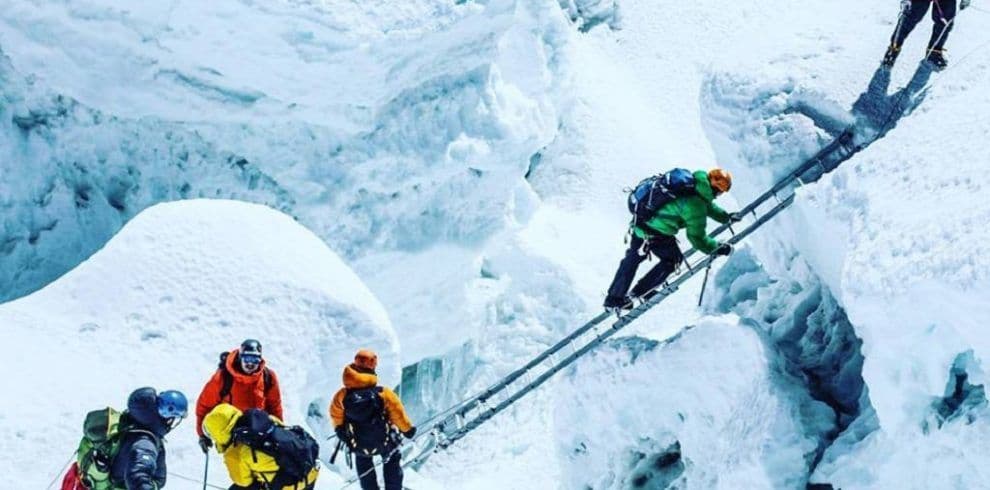
Island Peak Ascent (6,189m/20,305ft), from early about 3am in the morning will have to start climb the rock gully towards the summit. This is not difficult but there are several short rock steps to climb before you emerge on the right side of the gully. The route then follows a ridgeline, which leads to an exhilarating and exposed traverse onto the snout of the summit glacier. You will need to rope up for the glacier as it contains several crevasses but it leads without difficulty to a 100m(330ft) snow and ice slope (40-45°) on which the guides will fix a rope. From the top of this slope, it is 3 rope lengths along a sharp summit ridge lead to the top. After enjoying the summit views you will descend all the way to Base Camp and then Chhukung. (Overnight at Tea House Lodge – Chhukung) Meals included: Breakfast, lunch and dinner
The trail makes a gradual descent through scrub junipers and around Mani stones as it follows the hillside. The trail passes many Mani walls in deep rhododendron forests where crossing after the Imja khola, the trail climbs many carved Mani stones to Pangboche. Pangboche Gompa is the oldest in Khumbu; a visit will be well worth it. (Overnight at Tea House Lodge – Tengbouche) Meals included: Breakfast, lunch and dinner
This is the day to return back Namchhe Bazaar and the path leads downhill to Phungitenga and we continue flat trail until Namchhe. Here you can explore The Everest National Park Museum which houses many mountaineering and Himalayan artifacts. (Overnight at Tea House Lodge – Namche) Meals included: Breakfast, lunch and dinner
We trek back to Lukla through same route, crossing several suspension bridges and Sherpa settlements. Our goal today is to reach Lukla before the sunset for celebration of our successful trip. (Overnight at Tea House Lodge – Lukla) Meals included: Breakfast, lunch and dinner
We take scenic flight back to Kathmandu. And maybe you can do shopping or buy souvenirs for your friends and family. Or better you can relax, have some massage and dine the best meals of the city in some of the best restaurants. (Overnight at Hotel) Meals included: Breakfast, lunch and dinner. Attend the evening dinner and cultural program provided by our company.
After winding up a successful trip, our representative drops you off to the airport for your further journey. You are dropped to the airport around 3 hours before the departure so that there may not be any delays. Have a safe journey!
Frequently asked questions
Quick answers about this trip. Still unsure? Our team is happy to help.
Nepal, as a tourist destination is good for all seasons, however, the best seasons for trekking to EBC and Island peak climbing are Spring (March – May) and Autumn (mid Sept. – mid Dec. ). Trekking in autumn season is noted for clear weather and excellent views of silvery mountains against blue sky. It gets colder towards the end of December. This trek can be done in any month except January and February.
Nepal, as a tourist destination is good for all seasons, however, the best seasons for trekking to EBC and Island peak climbing are Spring (March – May) and Autumn (mid Sept. – mid Dec. ). Trekking in autumn season is noted for clear weather and excellent views of silvery mountains against blue sky. It gets colder towards the end of December. This trek can be done in any month except January and February.
Nepal, as a tourist destination is good for all seasons, however, the best seasons for trekking to EBC and Island peak climbing are Spring (March – May) and Autumn (mid Sept. – mid Dec. ). Trekking in autumn season is noted for clear weather and excellent views of silvery mountains against blue sky. It gets colder towards the end of December. This trek can be done in any month except January and February.
Nepal, as a tourist destination is good for all seasons, however, the best seasons for trekking to EBC and Island peak climbing are Spring (March – May) and Autumn (mid Sept. – mid Dec. ). Trekking in autumn season is noted for clear weather and excellent views of silvery mountains against blue sky. It gets colder towards the end of December. This trek can be done in any month except January and February.
Nepal, as a tourist destination is good for all seasons, however, the best seasons for trekking to EBC and Island peak climbing are Spring (March – May) and Autumn (mid Sept. – mid Dec. ). Trekking in autumn season is noted for clear weather and excellent views of silvery mountains against blue sky. It gets colder towards the end of December. This trek can be done in any month except January and February.
Nepal, as a tourist destination is good for all seasons, however, the best seasons for trekking to EBC and Island peak climbing are Spring (March – May) and Autumn (mid Sept. – mid Dec. ). Trekking in autumn season is noted for clear weather and excellent views of silvery mountains against blue sky. It gets colder towards the end of December. This trek can be done in any month except January and February.
Nepal, as a tourist destination is good for all seasons, however, the best seasons for trekking to EBC and Island peak climbing are Spring (March – May) and Autumn (mid Sept. – mid Dec. ). Trekking in autumn season is noted for clear weather and excellent views of silvery mountains against blue sky. It gets colder towards the end of December. This trek can be done in any month except January and February.
Nepal, as a tourist destination is good for all seasons, however, the best seasons for trekking to EBC and Island peak climbing are Spring (March – May) and Autumn (mid Sept. – mid Dec. ). Trekking in autumn season is noted for clear weather and excellent views of silvery mountains against blue sky. It gets colder towards the end of December. This trek can be done in any month except January and February.
Nepal, as a tourist destination is good for all seasons, however, the best seasons for trekking to EBC and Island peak climbing are Spring (March – May) and Autumn (mid Sept. – mid Dec. ). Trekking in autumn season is noted for clear weather and excellent views of silvery mountains against blue sky. It gets colder towards the end of December. This trek can be done in any month except January and February.
Nepal, as a tourist destination is good for all seasons, however, the best seasons for trekking to EBC and Island peak climbing are Spring (March – May) and Autumn (mid Sept. – mid Dec. ). Trekking in autumn season is noted for clear weather and excellent views of silvery mountains against blue sky. It gets colder towards the end of December. This trek can be done in any month except January and February.
Nepal, as a tourist destination is good for all seasons, however, the best seasons for trekking to EBC and Island peak climbing are Spring (March – May) and Autumn (mid Sept. – mid Dec. ). Trekking in autumn season is noted for clear weather and excellent views of silvery mountains against blue sky. It gets colder towards the end of December. This trek can be done in any month except January and February.
Leave a review
Travelled with us? Share your experience. Your email address will not be published.
Planning a trip to Nepal?
Tell us what you have in mind and we’ll tailor a trip around you.