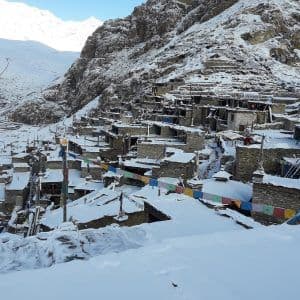
Nar Phu valley trek is also one of the best remote area trekking in Nepal. It will be the best opportunity to experience an amazing view of Himalaya, Tibetan Buddhist culture, ancient village and many more. This trek is established for tourist since 2003 A.D. Nar Phu trek takes you the remote part of Nepal densely populated by Nepalese Tibetans who depend on livestock.
Where is Nar Phu valley Trek located?
Nar and Phu are two separate villages located at the Manang district. It is located on the north of Annapurna range towards southern border of Tibet. Their people speak their own unique and rare Narpa language.
How Difficult Nar Phu valley trip is?
Nar Phu valley trip is the moderate trip. This trip starts Moderate to hard. That’s why you need some physical fitness.
How long will it take for Nar Phu valley Trek?
Nar Phu valley trip is around 8-12 days but if you go forward for your trip on Manaslu trip it may take almost 25 days but trips are fully customizable. So it’s depended upon your interest and holidays.
What type of Physical fitness do I have for Nar Phu valley Trekking?
The entire trek needs some physical fitness. Likewise, this trip also demanded some physical fitness. You have to walk approximately 5-6 hours each day. So it’s better to do some regular exercise before your trek.
What is the Best time to go to Nar Phu valley trek?
Autumn (September-November), is regarded as the best season for the trek in Nepal. In the season you can experience the beautiful mountain, green hills. Generally, the weather is clear with mild to warm days and cold nights. Nepalese festivals Dashain and Tihar are celebrated on this season.
Winter (December- February), in the season, the Himalayan region freezes and the snow falls. In higher altitude trekking could be challenging because the trail can be covered with snow. But in lower altitude below 3000m you can trek.
Spring (March-May) is also the good season for the trek. During this season, flowers bloom, lush greenery, and sparkling mountains is an excellent background to spring trekking.
Summer (June-August) is the monsoon season. Trekking is very uncomfortable because of the trail becomes muddy and wet.
What type of Food and Accommodation available during Nar Phu valley Trekking?
Accommodation and food are the main key point for any trekkers during the trek. In Nur Phu, it is possible as teahouse trek and homestay trek. In this trip, you don’t need camp. Likewise, mostly you will get there Dal Bhaat. Rice will serve in Narpa style and culture with vegetable, curry, salad, lentils, chutney, and meat.
What are the highlights of Nar Phu valley Trek?
Spectacular views of the Annapurna massive, Lamjung and Manaslu
Explore the lovely village of Nar and Phu, Manang, Ngawal village and the old monasteries in Phu village
Fantastic views of the sunrise lake city of Pokhara
Trek through daring Kang La and Thorong La passes offering dramatic Himalayan Panorama
The chance to discover the world’s deepest gorge- the Kaligandaki, and take a scenic mountain flight from Jomsom
Why do I need guide and porter for Nar Phu valley Trek?
Guide and porter are very important for your trip because they help you to make your trip more convenient and comfortable. We will provide you guide with certificate and well trainer. They have also the good knowledge of trail, community culture, and lifestyle of that place. So that you will not get any trouble to eat and stay for the night. In this trip, you have to walk around 5-6 hours. So it may be difficult for your trip along bags. In that case, porter helps you to carry your baggage for you. They are very honest too.
What should I bring during Nar Phu valley Trekking?
While the plan for the trek you should well prepare before you start your trip. Cloths will vary a little according to the season and the trek duration.
Head
Sunglasses with UV protection
Headlamp with extra batteries and bulbs
The warm hat that covers your ears
Bandana or head scarf
Upper Body
Down vest/jacket
Waterproof shell jacket
Light and expedition weight thermal tops
Gore-Tex jacket with hood, waterproof and breathable
Hands
1 pair of lightweight poly-liner gloves
1 pair of lightweight wool or fleece gloves
1 pair of mittens
Lower Body
1 pair of Hiking shorts
1 pair of hiking trousers
1 pair of fleece or woolen trousers
1 pair of waterproof shell pants
Feet
2 pairs of thin inner socks
1 pair of hiking boots
2 pairs of heavy poly or wool socks
1 pair of trainers or running shoes
Sleeping
1 sleeping bag temperature -20 degrees celsius
Is there any ATMs facility available during Nar Phu valley trek?
Nar Phu is remote areas. So, it may difficult to find out bank or ATM in this place. So it’s better to take enough cash from Kathmandu for your trek. So that, you will not have to face any kind of cash problem in your trek.
What about the internet and battery charge during Nar Phu valley Trek?
Most of the place of Nar Phu has the solar system and some have hydroelectricity system. If you want to charge your camera, cell phone, battery, in that case, you should pay extra cash for that. In other hands, it’s safe to carry your electronics with you.
How many hours do I need to walk for Nar Phu valley trek?
You have to walk almost 5-6 hours per day. The route of someplace is steeply ascended or descends. Time duration can be up and down as your fitness.
Do I need travel insurance for Nar Phu valley trek?
Travel insurance is very important and the main thing for any traveler while traveling to other countries. So it’s necessary to do travel insurance while taking Nar Phu Trip.
What about altitude sickness during the Nar Phu valley trek?
Altitude sickness is also known as mountain sickness. Mountain sickness is the main problem for any mountain trekkers. Sometimes trekkers might have altitude sickness during EBC trek. There are different types of sickness like:
AMS – Acute Mountain sickness – AMS is a very common sickness like a hangover, dizziness, muscle ache, nausea, headache, vomiting and many more.
HAPE – High Altitude Pulmonary Edema – HAPE direct impact on lungs it’s fluid in the lungs which are dangerous for breathing.
HACE- High Altitude Cerebral Edema – HACE it’s the different form of altitude sickness its fluid in the brains.
Thus, HACE and HAPE are the main dangerous and life-threatening form of mountain sickness. Patient has to treat on time if not treated on time if late they may die. Whereas AMS is normal mountain sickness then HACE and HAPE.
What about communication during Nar Phu valley trek?
Most of the place has a good local telephone network system of Ncell and NTC. However, some places may not cover the network. Otherwise, you can easily get the network in that place. Our guide and porter have also the cellphone to contact.

Leave a reply
Your email address will not be published.